




Standing out in the crowded beauty e-commerce market in Spain can feel overwhelming when every brand vies for attention across Instagram, TikTok, and Facebook. Modern consumers crave more than just great packaging and pretty photos—they expect brands to reflect authentic values and cultural relevance. Discover how well-defined brand positioning and innovative social media strategies can help your beauty startup spark real engagement, communicate your unique story, and cut through the online noise.
Table of Contents
- Step 1: Define Your Unique Beauty Brand Positioning
- Step 2: Develop Engaging Social Media Content Strategies
- Step 3: Implement Targeted Paid Advertising Campaigns
- Step 4: Leverage AI Tools For Audience Insights
- Step 5: Measure Results And Refine Your Approach
Quick Summary
| Key Point | Explanation |
|---|---|
| 1. Define Your Brand Positioning | Create a strategic narrative that sets your beauty brand apart, focusing on genuine values and unique strengths. |
| 2. Develop Engaging Social Media Content | Craft authentic, visually appealing content that fosters meaningful interactions and reflects your brand’s personality. |
| 3. Implement Targeted Paid Advertising | Use precise targeting strategies to reach ideal customers effectively with compelling advertisements that resonate with them. |
| 4. Utilize AI for Audience Insights | Employ AI tools to gather in-depth consumer data and understand preferences, enabling personalized marketing strategies. |
| 5. Measure Results and Refine Approaches | Regularly track marketing performance metrics to optimize strategies and ensure continuous improvement in engagement and sales. |
Step 1: Define your unique beauty brand positioning
Defining a unique beauty brand positioning is about creating a strategic narrative that distinguishes your brand in a competitive marketplace. Your positioning will communicate why customers should choose your brand over countless alternatives, crafting a compelling story that resonates with your target audience.
To develop a powerful brand positioning, you’ll need to conduct deep research into market trends and consumer preferences. Beauty market insights reveal that modern consumers – especially younger generations – are seeking brands with authentic values beyond traditional beauty standards. This means your positioning must go deeper than product features.
Start by identifying your core differentiators through a strategic process:
- Analyze your brand’s unique strengths
- Understand your target demographic’s specific needs
- Evaluate competitor positioning to find untapped market opportunities
- Define clear, authentic brand values that genuinely reflect your mission
Your brand positioning should articulate what makes you uniquely valuable. Are you championing sustainability? Celebrating diverse beauty standards? Offering scientifically advanced formulations? Choose a narrative that feels genuine and compelling.
Your brand positioning is more than a marketing strategy – it’s your promise to consumers about who you are and what you stand for.
Research your target audience meticulously. Understand their aspirations, challenges, and emotional triggers. The most successful beauty brands don’t just sell products – they offer experiences and connect on a deeper emotional level.
Pro tip: Conduct periodic positioning audits to ensure your brand narrative remains relevant and resonant with evolving consumer expectations.
Step 2: Develop engaging social media content strategies
Developing compelling social media content strategies is crucial for beauty brands looking to build a strong online presence and connect authentically with their target audience. Your content must go beyond simple product promotion to create meaningful interactions that resonate with potential customers.
Social media marketing for beauty brands demands authentic storytelling that celebrates diversity, inclusivity, and real consumer experiences. This approach requires a strategic blend of visual creativity, responsive engagement, and genuine brand personality.
Key elements of an effective social media content strategy include:
- Create visually stunning content that showcases product benefits
- Develop consistent brand storytelling across all platforms
- Incorporate user-generated content and testimonials
- Leverage influencer partnerships strategically
- Respond promptly and personally to audience interactions
Your social media content should feel like a conversation, not a billboard advertisement.
Understand your target audience’s preferences by analyzing engagement metrics and feedback. This means tracking which types of content generate the most interaction, whether it’s tutorial videos, before-and-after transformations, or behind-the-scenes brand stories.
Visual consistency is critical. Develop a recognizable aesthetic that immediately communicates your brand’s unique identity. This might involve a specific color palette, photography style, or graphic design approach that sets you apart from competitors.

Remember that social media is a two-way communication channel. Encourage audience participation through interactive content like polls, Q&A sessions, and challenges that invite followers to engage directly with your brand.
Pro tip: Create a content calendar that balances promotional posts with educational, entertaining, and community-building content to maintain audience interest and engagement.
Step 3: Implement targeted paid advertising campaigns
Implementing targeted paid advertising campaigns is a sophisticated strategy that can dramatically accelerate your beauty brand’s online growth and customer acquisition. Your goal is to create precision-targeted campaigns that reach the right audience with the right message at the right moment.
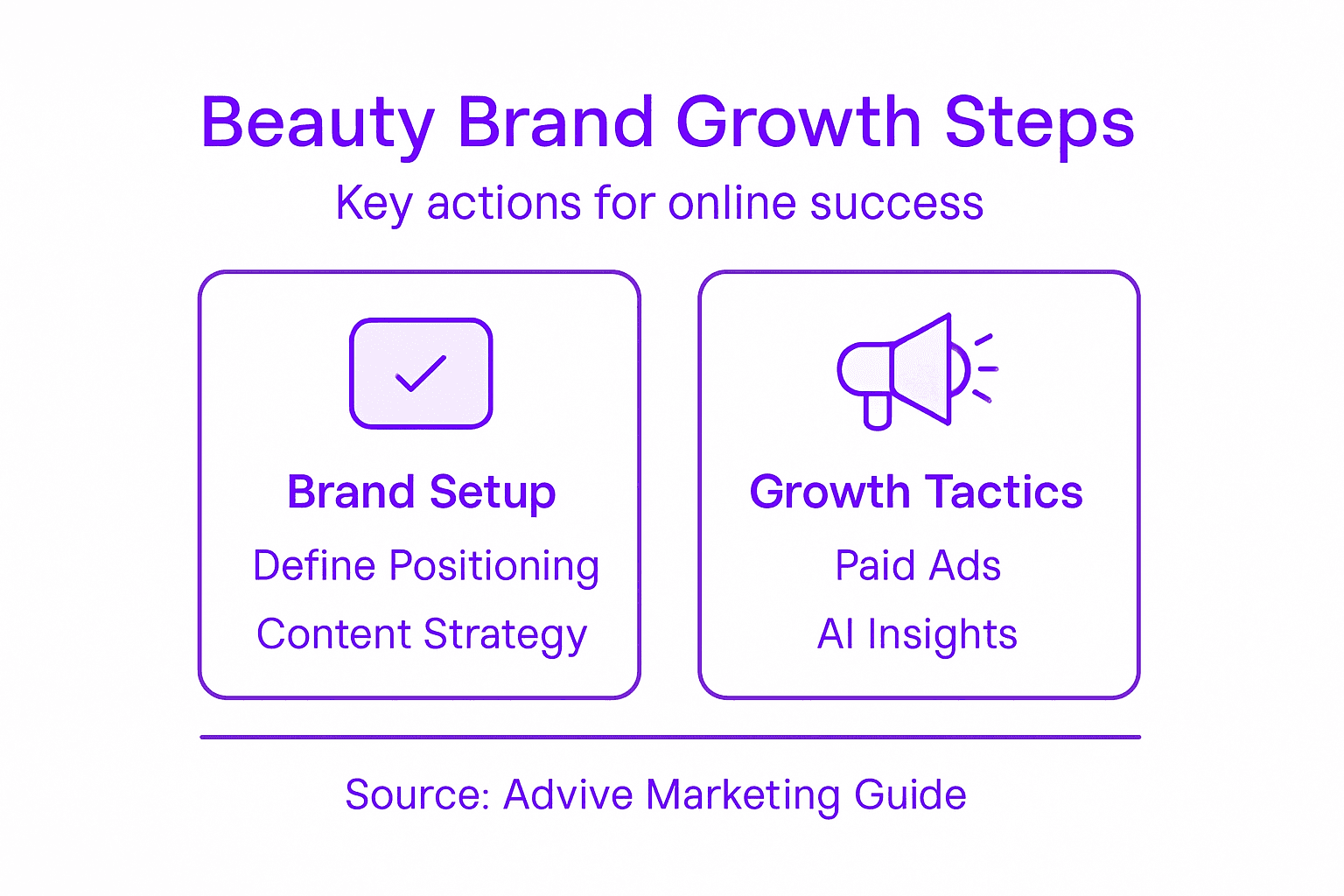
AI-powered advertising strategies are revolutionizing how beauty brands connect with potential customers by enabling hyper-personalized ad delivery through advanced consumer behavior analytics. This means moving beyond traditional demographic targeting to develop truly intelligent marketing approaches.
Key components of an effective paid advertising strategy include:
- Define your ideal customer persona with extreme precision
- Select platforms that align with your target audience’s preferences
- Develop visually compelling ad creative
- Implement advanced audience segmentation
- Create multiple ad variations for A/B testing
- Monitor and adjust campaigns in real-time
Successful paid advertising is about quality targeting, not just quantity of impressions.
Understand the nuanced differences between advertising platforms. Instagram and TikTok might work best for visually driven beauty content, while Facebook offers more detailed targeting options. Each platform requires a tailored approach that respects its unique audience dynamics.
Utilize first-party data and pixel tracking to refine your targeting continuously. This means collecting and analyzing user interactions, website visits, and engagement metrics to create increasingly precise audience segments.
Craft ad copy that speaks directly to your audience’s desires and pain points. Your messaging should feel personal, authentic, and aligned with the specific needs of different customer segments.
Pro tip: Allocate 20% of your advertising budget to experimental campaigns that test innovative targeting approaches and creative concepts.
See how key digital platforms differ for beauty marketing:
| Platform | Key Strength | Ideal Audience |
|---|---|---|
| High visual impact | Millennials & Gen Z | |
| TikTok | Viral short videos | Gen Z, trend-seekers |
| Detailed targeting | Broad demographics | |
| YouTube | Long-form storytelling | Tutorials & reviews fans |
Step 4: Leverage AI tools for audience insights
Leveraging AI tools for audience insights represents a transformative approach to understanding your beauty brand’s potential customers with unprecedented depth and precision. These advanced technologies enable you to uncover nuanced consumer behaviors and preferences that traditional market research methods could never capture.
Generative AI market research techniques are revolutionizing how beauty brands develop consumer understanding by creating synthetic personas and digital simulations of customer behavior. This allows for rapid, cost-effective exploration of complex audience segments and potential marketing strategies.
Key strategies for implementing AI-driven audience insights include:
- Select AI platforms specialized in consumer behavior analytics
- Integrate multiple data source inputs
- Create detailed customer persona models
- Analyze real-time social media conversations
- Track emerging beauty trend patterns
- Develop predictive consumer behavior models
AI insights transform raw data into strategic marketing intelligence.
Understand that AI tools are not just data collectors but sophisticated interpretation engines. They can help you predict emerging trends, understand subtle emotional drivers behind consumer choices, and create highly personalized marketing approaches.
Focus on platforms that offer comprehensive analysis across different channels. The most powerful AI tools will synthesize data from social media interactions, product reviews, website behaviors, and demographic information to create holistic audience profiles.
Translate AI insights into actionable marketing strategies by continuously refining your understanding of customer segments and their evolving preferences.
Pro tip: Invest in AI tools that offer explainable insights, allowing you to understand not just the data but the reasoning behind consumer behavior predictions.
Step 5: Measure results and refine your approach
Measuring marketing effectiveness transforms your beauty brand’s strategy from guesswork to precision-driven decision making. By systematically tracking and analyzing your performance, you’ll create a continuous improvement loop that keeps your marketing efforts sharp and responsive.
Marketing effectiveness evaluation requires defining clear objectives at each stage of the customer journey and tracking relevant metrics that reveal your true performance. This data-driven approach allows you to identify strengths, optimize resource allocation, and refine campaigns for maximum impact.
Key metrics to track across your marketing funnel include:
- Awareness metrics: Reach, impressions, brand mentions
- Engagement metrics: Likes, comments, shares, video views
- Conversion metrics: Website traffic, lead generation, sales
- Revenue metrics: Customer acquisition cost, lifetime value
- Retention metrics: Repeat purchases, customer loyalty rates
Success is not about perfect performance, but consistent improvement and strategic adaptation.
Develop a comprehensive analytics dashboard that provides real-time insights into your marketing performance. This should integrate data from multiple channels, giving you a holistic view of your brand’s digital presence.
Remember that measurement is not just about collecting numbers but interpreting them intelligently. Look for patterns, correlations, and actionable insights that can guide your future marketing strategies.
Compare your performance against industry benchmarks to understand how your beauty brand stands in the competitive landscape. This helps you set realistic goals and identify areas for strategic growth.
Pro tip: Schedule monthly review sessions to deep-dive into your analytics, ensuring your marketing approach remains agile and responsive to changing market dynamics.
Here’s a summary of how each marketing step benefits a beauty brand:
| Step | Main Focus | Business Impact |
|---|---|---|
| Define Positioning | Strategic differentiation | Attracts loyal customer base |
| Social Media Strategy | Engaging content | Builds brand awareness rapidly |
| Paid Advertising | Targeted outreach | Accelerates customer acquisition |
| AI Audience Insights | Data-driven understanding | Personalizes marketing for conversions |
| Measure & Refine | Performance tracking | Supports continuous improvement |
Elevate Your Beauty Brand with Expert Marketing Strategies
Navigating the competitive beauty market means mastering unique positioning, authentic social media engagement, and targeted advertising that truly connects. If you are striving to overcome challenges like reaching the right audience or translating AI insights into real growth, you need a partner who understands these complexities. Adviver Marketing specializes in creating tailored content strategies, managing paid ads on platforms like Meta and TikTok, and integrating AI-powered tools to keep your brand ahead. Discover how to transform your strategic vision into measurable success.
Ready to accelerate your beauty brand’s online growth with personalized attention and creative partnership? Visit Adviver Marketing and explore our Uncategorized Archives – Adviver Marketing for expert insights and actionable solutions. Take the next step in unlocking your brand’s full potential today.
Frequently Asked Questions
How can I define my beauty brand’s unique positioning?
To define your beauty brand’s unique positioning, analyze your brand’s strengths, understand your target demographic’s needs, and evaluate your competitors. Start by outlining what makes your brand stand out, such as sustainability or celebrating diversity, and ensure your values reflect this narrative.
What are effective strategies for social media content for beauty brands?
Effective strategies include creating visually appealing content, maintaining consistent storytelling, and engaging with your audience through user-generated content and influencer partnerships. Develop a content calendar to balance promotional and engaging posts, aiming to keep your audience interested every week.
How do I implement targeted paid advertising campaigns for my beauty brand?
To implement targeted paid advertising, define your ideal customer persona and select the right platforms. Create visually compelling ads and utilize audience segmentation to ensure your campaigns reach the right consumers, adjusting your strategies based on real-time performance data.
What AI tools can help with audience insights for my beauty brand?
Utilize AI tools that specialize in consumer behavior analytics to enhance your understanding of audience preferences. Focus on platforms that combine data from various sources to create detailed customer persona models and track emerging trends in real-time.
How can I measure the effectiveness of my beauty brand’s marketing efforts?
Measure effectiveness by tracking key metrics such as brand awareness, engagement, conversions, and customer retention rates. Develop a comprehensive analytics dashboard that allows you to analyze these metrics monthly, ensuring your strategies are continually refined for better results.
Recommended
- How a Beauty Marketing Agency can transform your social media presence – Adviver Marketing
- AI Social Media Services | Data-Driven Growth | Adviver
- Social Media Agency Portfolio | Adviver Marketing
- Marketing for Entrepreneurs Made Simple – Adviver Marketing
Article generated by BabyLoveGrowth